Rough Raw Affinity Brushes: A Practical Evaluation
The transition from tablet-based sketching to desktop illustration often introduces a specific set of workflow challenges. Artists accustomed to the tactile responsiveness of an iPad frequently find that their digital toolkits lose some of their organic character when moved to a larger screen environment. The Rough Raw Affinity Brushes set addresses this gap directly, offering a curated collection designed to bridge the divide between mobile and desktop creation within the Affinity Designer and Photo ecosystems. This is not merely a bundle of generic strokes; it is a specialized resource aimed at professionals who require consistent, textured output across different devices.
For creators working in lettering, editorial design, or hand-drawn illustration, the ability to maintain a "rough edge" without sacrificing precision is critical. The Rough Raw collection has gained traction because it replicates the unpredictability of physical media—charcoal, dry ink, and worn paper—using high-fidelity digital algorithms. By analyzing the structure and application of these brushes, we can determine their practical value for serious practitioners who need reliable tools rather than novelty assets.
Cross-Platform Consistency and Workflow Integration
One of the most significant advantages of the Rough Raw Affinity Brushes is its seamless compatibility across platforms. Historically, brush sets were often optimized specifically for the Apple Pencil on iPadOS, leaving desktop users with inferior alternatives or requiring complex workarounds. This set changes that dynamic. Because the brushes are built natively for the Affinity engine, they perform identically whether you are sketching on an iPad Pro or refining a final piece on a desktop monitor.
This cross-platform consistency is vital for modern workflows. A designer might begin a concept sketch during a commute on a tablet, then move to a desktop workstation to finalize the vector paths and add complex textures. With Rough Raw, the visual language of the artwork remains intact throughout this process. The stroke dynamics, pressure sensitivity, and texture distribution do not shift unexpectedly when the file is opened on a different device. This reliability reduces friction in the creative process, allowing the artist to focus on composition and execution rather than troubleshooting tool behavior.
Anatomy of the Brush Set: Lines and Textures
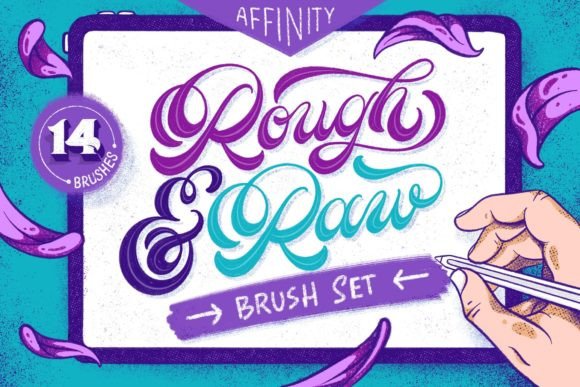
The collection is logically divided into two distinct categories: seven line brushes and seven texture brushes. This segmentation suggests a thoughtful approach to the illustration pipeline, covering the stages from initial construction to final rendering.
The Line Brushes
The seven line brushes are engineered for sketching and inking. Unlike standard round brushes that produce uniform, sterile lines, these tools introduce controlled variation. They mimic the behavior of dry mediums, where the tip breaks slightly under pressure or speed, creating a natural irregularity. For lettering artists, this is essential. Hand-lettered work relies heavily on the contrast between thick and thin strokes, as well as the subtle imperfections that signal human craftsmanship. These line brushes allow for rapid, confident mark-making that retains a raw aesthetic without requiring manual post-processing.
In practice, these brushes excel at creating outlines for characters, architectural sketches, and typographic elements. The pressure curve appears calibrated to respond well to both light tapping for fine details and heavy dragging for bold strokes. This versatility makes them suitable for both rough ideation and finished line art, provided the artist adjusts the flow and opacity settings to suit the specific project requirements.
The Texture Brushes
The second half of the set focuses on surface treatment. The seven texture brushes are derived from real-life scans, capturing the granular quality of paper, canvas, and distressed surfaces. In digital illustration, flat colors can sometimes feel lifeless. These brushes inject depth by overlaying noise and grain that interacts dynamically with the underlying layers.
When applied over solid color fills or gradients, these texture brushes create a unified, cohesive look. They are particularly effective for adding weathering effects, background patterns, or shading that mimics traditional washes. The key strength here is the randomness algorithm; the textures do not repeat in obvious loops, which is a common pitfall in lower-quality brush packs. Instead, they distribute particles organically, ensuring that no two strokes look exactly alike. This quality is crucial for maintaining the illusion of handmade art in a digital medium.
Real-World Performance and Usability
Evaluating the performance of Rough Raw Affinity Brushes requires looking beyond the marketing claims to how they behave under pressure. In testing scenarios involving large-scale illustrations, the brushes demonstrated strong stability. There was minimal lag even when applying multiple texture layers on high-resolution canvases, a common issue with poorly optimized brush engines.
The installation process is straightforward, supported by an included guide that simplifies the setup for users unfamiliar with Affinity's brush management system. Once installed, the brushes integrate immediately into the interface, ready for use without additional configuration. However, users should note that while the default settings provide excellent results, achieving the perfect "handmade" look may require tweaking the scatter, size jitter, and wetness parameters depending on the specific project scale.
A potential limitation to consider is the learning curve associated with textured brushes. While the line brushes are intuitive, the texture brushes require a degree of experimentation to master. Users accustomed to clean, vector-perfect lines may initially find the rough edges difficult to control. It takes time to develop a feel for how much pressure to apply to achieve the desired density of texture. Nevertheless, once mastered, these tools offer a level of artistic expression that standard vector pens cannot replicate.
Ideal Use Cases and Target Audience
The Rough Raw Affinity Brushes are best suited for professionals and hobbyists who prioritize organic aesthetics in their digital work. This includes:
- Lettering Artists and Calligraphers: Those creating custom typography will find the line brushes invaluable for adding character and movement to their scripts.
- Illustrators and Concept Artists: Professionals needing to rapidly generate mood boards or finished pieces with a gritty, realistic style.
- Brand Designers: Marketers looking to infuse a brand identity with a human, artisanal touch through logos and packaging designs.
- Freelancers: Creators who need to deliver unique assets quickly without spending hours manually painting textures.
These brushes are less relevant for designers working strictly in corporate minimalism or technical illustration, where precision and cleanliness are paramount. If your workflow demands pixel-perfect symmetry and smooth curves, the inherent roughness of this set may be counterproductive. However, for anyone aiming to break away from the "digital sheen," Rough Raw offers a robust solution.
Long-Term Value and Investment
From a cost-benefit perspective, the inclusion of 14 distinct brushes plus an installation guide represents a solid investment for expanding one's digital toolkit. The longevity of these assets is high because they are based on fundamental principles of traditional art rather than fleeting trends. The demand for authentic, textured visuals in web design, advertising, and social media content continues to grow as audiences seek more genuine connections with brands.
Furthermore, the ability to use these brushes across both iPad and Desktop extends their utility significantly. You are essentially purchasing a single asset that serves two distinct workstations, doubling the return on investment compared to platform-specific alternatives. For freelancers and small business owners, this efficiency translates to faster turnaround times and a broader range of stylistic options available to clients.
Conclusion
The Rough Raw Affinity Brushes set stands out as a functional, high-quality resource for digital artists seeking to emulate the charm of traditional media. Its division into line and texture components provides a comprehensive toolkit for the entire illustration process, from initial sketch to final polish. While it requires a brief period of adjustment to master the texture controls, the payoff in terms of visual richness and workflow flexibility is substantial. For professionals operating within the Affinity ecosystem who value authenticity and cross-device consistency, this brush set offers a practical and powerful enhancement to their creative capabilities.